History of the Mont Blanc Ascent
Published May 2, 2026 · Updated July 19, 2026
Written by Victor Michel — history enthusiast and passionate alpinist based in Chamonix
The history of Mont Blanc is inseparable from the birth of mountaineering. Before becoming a sporting summit, it was a scientific, geographic and philosophical object. Its 1786 ascent by Jacques Balmat and Michel-Gabriel Paccard marks a major turning point in alpine history.
Timeline
The human epic and the evolution of gear, 1741–2026
1741
Early exploration: Windham, Pococke and the Alpenstock
English travelers William Windham and Richard Pococke venture into the Chamonix valley, then regarded as a wild, feared land — "the cursed mountains." They explore the glacier they name " La Mer de Glace ." Their account, published in London, triggers a wave of European curiosity for this corner of the Alps.
High-mountain equipment does not yet exist. Windham and Pococke travel in city clothes — tricorn hats, heavy common-wool coats — armed with Alpenstocks: long ash or hazel staffs over two meters long, tipped with a crude forged-iron point. Their smooth leather boots slip on bare ice.
1760
Horace-Bénédict de Saussure's scientific challenge
The young Geneva scientist Horace-Bénédict de Saussure travels to Chamonix, fascinated by Mont Blanc. He understands that conquering it would validate major physical and barometric theories, and pledges a cash reward to whoever finds a practicable route to the summit.
For twenty-six years, attempts fail. Equipment is the main obstacle: no way to anchor into bare ice, and the intense cold above 4,000 m paralyzes bodies clad in fabrics that absorb moisture and freeze almost instantly.
8 August 1786
The First Ascent: Balmat's daring and Paccard's genius
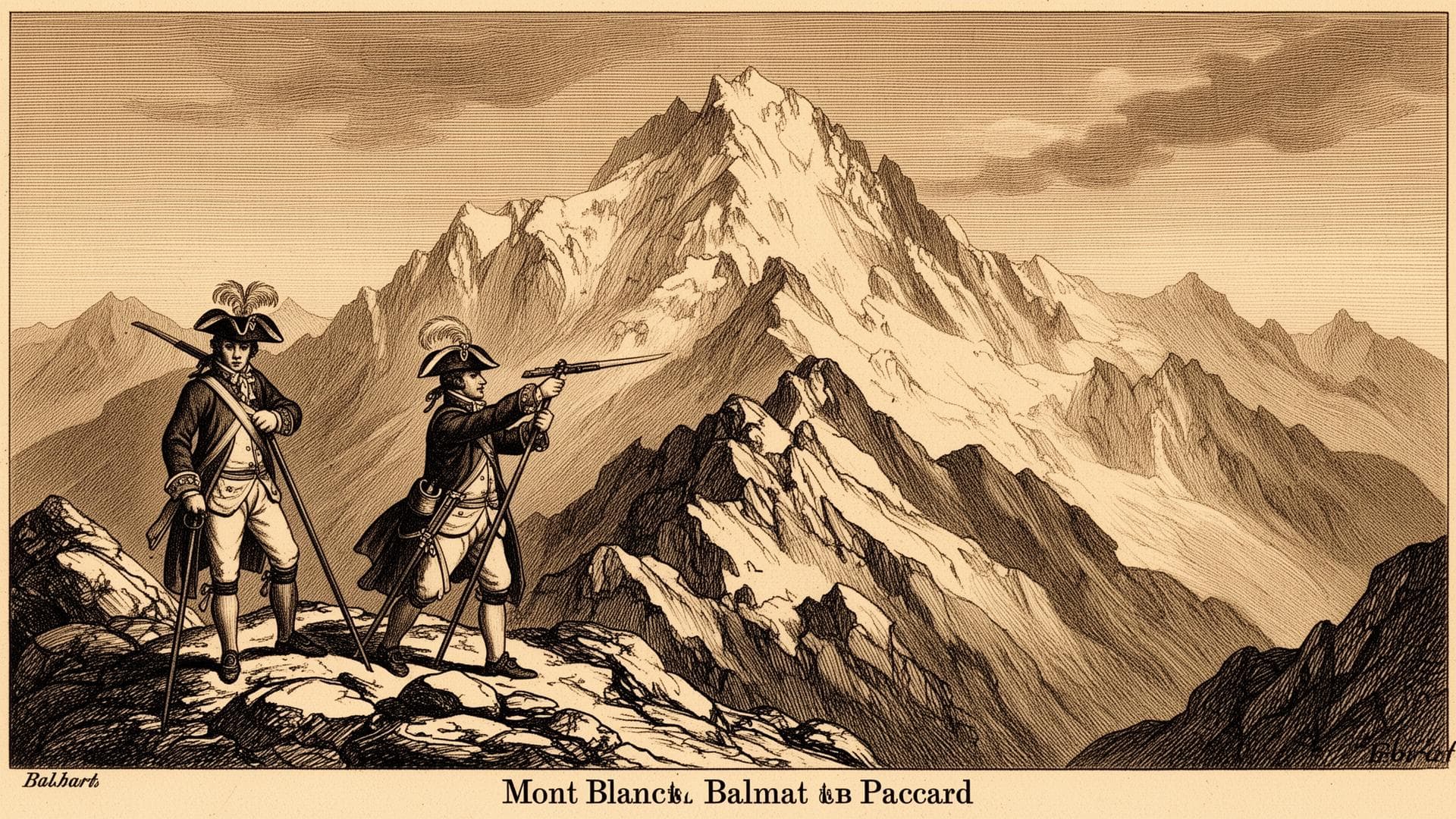
The crystal hunter Jacques Balmat and the doctor Michel-Gabriel Paccard shatter the myth of inaccessibility by reaching the summit, traditionally around 6:23 pm. There, Paccard takes atmospheric pressure measurements.
It is pure craftsmanship: their leather boots were studded one by one by the Chamonix blacksmith to bite into the ice. They wear layered flannel waistcoats, Bonneville-wool coats, and smoke-tinted glasses against snow blindness. Paccard carries his heavy glass barometer at arm's length. No rope, no piton: everything relies on balance with the Alpenstock.
1787
Saussure's scientific expedition and the first ladders
Saussure finally realizes his dream, accompanied by Jacques Balmat and a party of guides. It is the first time heavy logistics are deployed to cross the crevasses of the Bossons glacier.
The guides carry heavy fir-wood ladders, thick canvas tents, camp beds and coal stoves on their backs. The ancestor of expedition logistics is born.
1808
Marie Paradis, first woman at the summit
Marie Paradis becomes the first woman to reach the summit of Mont Blanc, largely carried and assisted by the guides of her roped party — a distinction history would draw compared to Henriette d'Angeville's self-reliant ascent thirty years later.
1818
The Grivel forge in Courmayeur: the beginnings of the alpine tool
On the Italian side of the massif, the Grivel family, blacksmiths of Walser origin, settle in Courmayeur and open the workshop that would become known as "Les Forges." Initially focused on farm tools, the forge responds within a few decades to a new demand: that of guides and the first wealthy tourists coming to climb the summits.
This is the birth of the Grivel brand, which would gradually adapt iron points and cutting tools to the needs of the high mountains, becoming one of the founding names in the history of the crampon.
1820–1821
The Hamel tragedy and the hemp trap: the birth of the Compagnie des Guides
The expedition of Russian doctor Hamel turns to tragedy below the Grand Plateau: an avalanche sweeps away the roped party. Three Chamonix guides — Pierre Balmat, Pierre Carrier and Auguste Tairraz — are buried and die. In response, the valley founds the Compagnie des Guides de Chamonix in 1821 to organize rescue and protect families.
This tragedy also exposes the flaws of the ropes of the time. Made of hemp, heavy, they absorb water and freeze until rigid as iron bars, with no elasticity whatsoever. In a fall, the hemp rope rubs against sharp ice, cuts through, or breaks outright under the static shock.
1838
Henriette d'Angeville and the weight of clothing traditions
Henriette d'Angeville becomes the first woman to climb Mont Blanc under her own power. The status of women at the time imposes strict clothing rules on her: a heavy culotte-skirt lined with Scottish wool, thick flannel underwear and a fur-trimmed pelisse — a full outfit weighing close to 7 kg, a considerable burden for exertion at altitude.
1870
The Simond forge settles in Chamonix
Adolphe Simond, nephew of blacksmith Auguste Simond, founds his first workshop on the banks of the Arve, in Chamonix, at the foot of Mont Blanc. In 1871 he forges his first ice axe there — the fusion of the Alpenstock and the ice hatchet into a single steel head with a blade and an adze.
His brothers François and Michel join him in 1883 and take the brand international, with the support of the famous English mountaineer Edward Whymper. In 1890, François Simond, himself a guide, refines the "piolette" and gives it its now-classic shape. Simond also begins forging rudimentary pitons and carabiners, finally giving the massif's mountaineers real technical self-reliance.
1861
The opening of the Goûter route: modern mountaineering takes shape
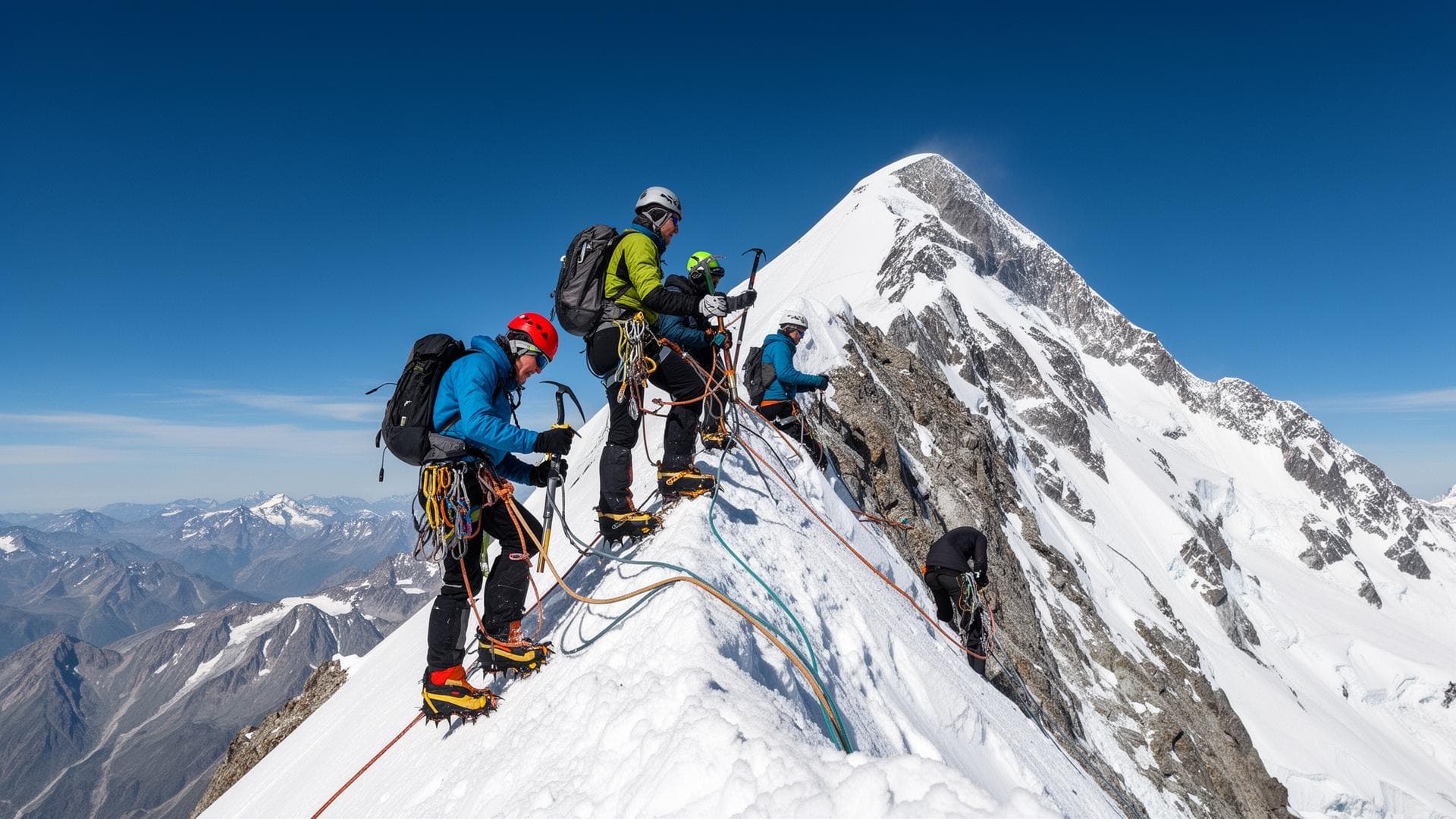
Leslie Stephen and Francis Fox Tuckett open the route via the Aiguille du Goûter and the Bosses ridge — today's Goûter normal route. This ascent establishes the Simond ice axe and the systematic use of the team rope to secure progress on the thin ridges.
1890
The Vallot challenge: engineering above 4,000 meters
The scientist Joseph Vallot has the observatory that bears his name built. Tons of scientific equipment and wooden beams are carried up on men's backs. It is there that the first observations on how metal, wood and gear behave under the massif's extreme freeze are made.
1908–1909
The invention of the modern crampon: Eckenstein and Grivel
English engineer Oscar Eckenstein designs a ten-point articulated crampon in 1908, then entrusts its forged-steel manufacture to Henry Grivel of Courmayeur. It is an absolute revolution for the massif: before this invention, climbing the Bosses ridge or the Mur de la Côte required cutting thousands of steps with an ice axe, exhausting work that took hours.
With the ten-point Grivel crampon, mountaineers finally walk directly on ice. Ascent time is cut in half, and safety multiplies.
Late 1920s–1930s
Hardened steel, front points and the conquest of the normal faces
Laurent Grivel, Henry's son, adds two forward-angled points to the traditional crampon. Mountaineers can now tackle steep slopes "front-pointing," without the exhausting hours of step-cutting. Simond, meanwhile, improves the strength of its carabiners with lighter steel alloys.
Textiles remain the weak point of the system, however: climbers still wear thick wool sweaters, stiff gabardine canvas jackets or heavy down jackets that soak up water under snow.
1964
The textile revolution and freedom of movement: Cimalp
Until the early 1960s, the Mont Blanc mountaineer remains stiffly bundled up. Cold is fought with thick layers of wool and oiled or waxed cotton — heavy gear that stiffens under frost and sacrifices almost all freedom of movement: lifting a leg high to clear a step, planting the ice axe overhead, everything becomes a fight against the clothing as much as against the mountain.
In 1964, Paul Sailler, a mountaineer and entrepreneur from Isère, founds the Cimalp brand in Saint-Marcel-lès-Valence, in the Drôme. With the Nemours spinning mills, he develops the first stretch pants designed specifically for mountaineering — a technical breakthrough that finally allows the fabric to follow the movement instead of resisting it.
In the 1970s, Cimalp's stretch-corduroy knickers achieve notable commercial success among French guides and mountaineers. In 1991, the brand is taken over by the Manufacture Drômoise de Confection and progressively repositions toward trail running and hiking gear — its current focus. In 2012, it develops the patented Ultrashell membrane, a waterproofing-breathability technology now used on its trail and hiking jackets.
1970s–1980s
The arrival of dynamic nylon and Béal ropes
Hemp is banned for good. Founded in 1976 in Saint-Julien-Molin-Molette, in the Loire, the Béal brand helps popularize mountain ropes made of nylon with a core-and-sheath structure. These so-called "dynamic" ropes stretch to absorb the kinetic energy of a fall.
On the Dôme du Goûter as elsewhere, a fall into a crevasse is now cushioned by the rope's elasticity, which protects both the climber and the roped party's anchor points — the exact opposite of the deadly rigidity of frozen hemp a century earlier.
2013
The "fast and light" era and Kilian Jornet's record
On 11 July 2013, athlete Kilian Jornet leaves the Chamonix church at 4:46 am and shatters the round-trip record to the summit of Mont Blanc: 4h57min40s in total, including 3h33 on the way up and 1h24 on the way down.
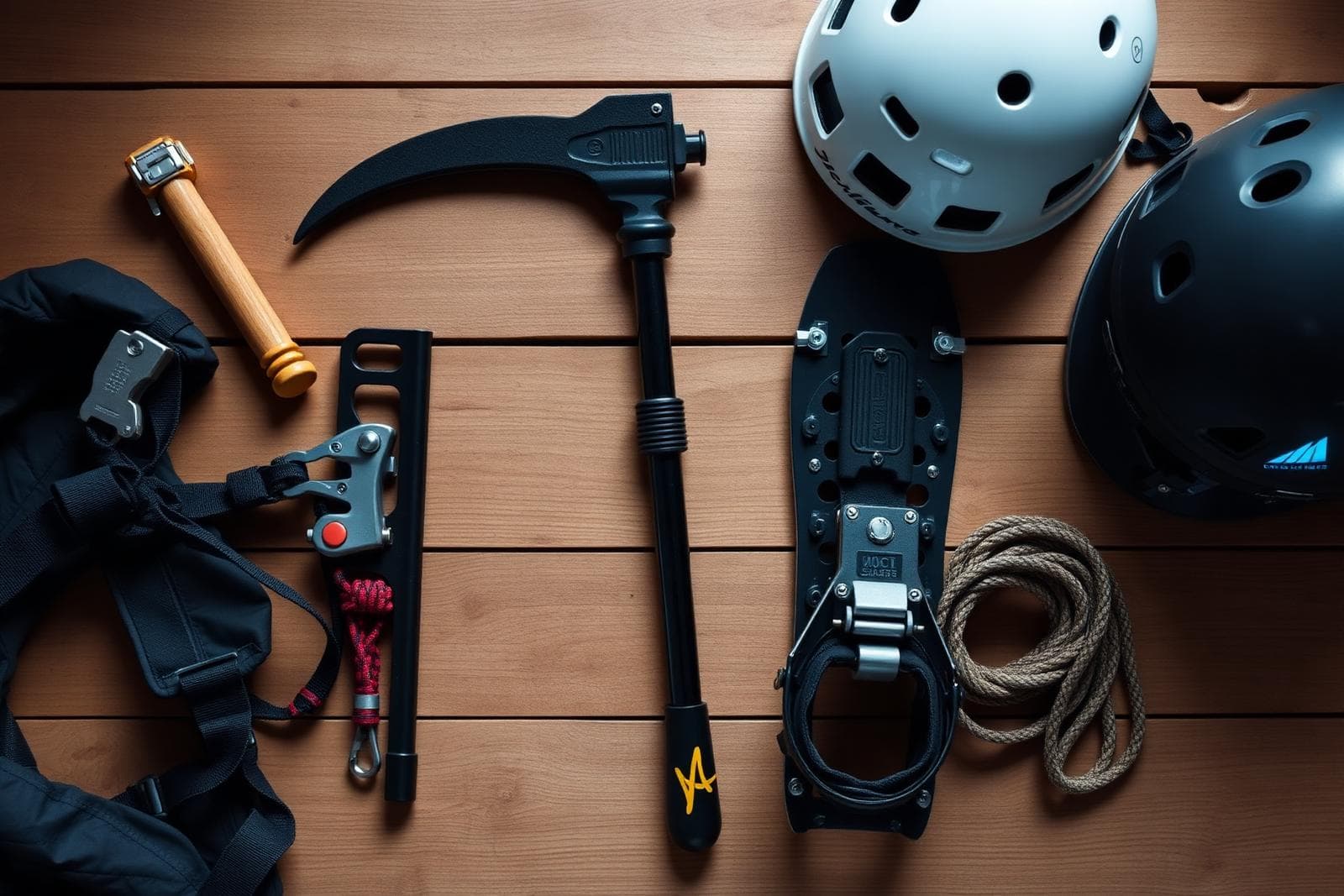
This feat marks the ultimate evolution of gear: absolute minimalism. The heavy equipment of the past gives way to hybrid trail shoes with micro steel spikes, ultra-light carbon-and-titanium ice axes weighing barely 200 g, and breathable, compressible technical layers that allow running at 4,000 m altitude.
2019 to today
Regulation by prefectoral order and gear as a matter of law
Faced with overcrowding and attempts made with clearly unsuitable gear, the Haute-Savoie prefecture publishes an order in May 2019 regulating the normal route. Since then, multi-day access via Tête Rousse, the Aiguille du Goûter and the Bosses ridge is only possible with a confirmed hut booking, and subject to individual and group gear suited to the standards defined by mountain professionals.
The PGHM and Saint-Gervais's "brigade blanche" carry out checks along the route. For the first time in the massif's history, technical gear falls within the scope of access regulation — an unprecedented legislative chapter, designed to preserve lives as much as to safeguard the summit.
Sources:
Wikipédia — Cimalp Wikipédia — Grivel Wikipédia — Oscar Eckenstein Wikipédia — Kílian Jornet
Historical figures