Ascent route
Climbing Mont Blanc via the Three Monts Traverse
The Three Monts traverse is the reference glaciated route to reach Mont Blanc's summit from Chamonix. Aesthetic and engaging, it links three peaks above 4,000 m — Mont Blanc du Tacul (4,248 m), Mont Maudit (4,465 m), and Mont Blanc (4,805.59 m) — in a high mountain atmosphere that the Goûter route does not offer.
Written by Victor Michel — history enthusiast and passionate alpinist based in Chamonix. Published May 2, 2026 · Updated August 26, 2026 · 10 min read
Quick summary
The Three Monts traverse departs from Aiguille du Midi (3,842 m) by cable car from Chamonix. After a night at Cosmiques refuge (3,613 m), the rope team departs at night across Géant Glacier, crosses Mont Blanc du Tacul (4,248 m), traverses or rappels the Mont Maudit Col (4,345 m), then climbs the Côte Wall to Brenva Col. The final ridge reaches the summit. Rated PD+ to AD− depending on conditions.
Key takeaways
- Departure from Aiguille du Midi (3,842 m) — cable car from Chamonix (~€65 round-trip)
- Cosmiques Refuge (3,613 m) — mandatory reservation via CAF or Chamonix Guides Company
- Three linked 4,000 m peaks: Tacul (4,248 m), Maudit (4,465 m), Mont Blanc (4,805.59 m — IGN 2021)
- Key passage: Mont Maudit Col (4,345 m) — seracs zone, 50 m rappel possible
- Côte Wall: slope 45°–50° over 200 m at more than 4,600 m altitude
- Rated PD+ to AD− depending on conditions — more technical than Goûter normal route
- Duration: 2 days (Day 1: cable car + Cosmiques; Day 2: night departure + summit)
Technical data
- Starting pointAiguille du Midi (3,842 m) — cable car from Chamonix (~€65 round-trip adults 2026)
- RefugeCosmiques Refuge (3,613 m) — CAF / Chamonix Guides Company — mandatory reservation
- Intermediate summitsMont Blanc du Tacul (4,248 m) · Mont Maudit (4,465 m)
- Summit altitude4,805.59 m (official measurement IGN/OGE 2021)
- Elevation gain+1,200 m from Cosmiques · +962 m from Aiguille du Midi
- Day 2 duration (summit)5–8 h climb from Cosmiques · 3–5 h descent
- Key passagesGéant Glacier, Tacul seracs zone, Mont Maudit Col (4,345 m), Côte Wall, Brenva Col
- Indicative ratingPD+ to AD− depending on conditions (ENSA / FFCAM)
- FaceFrance — Chamonix (departure and return by Aiguille du Midi cable car)
- Optimal seasonJune to September — July–August for stable snow conditions
Detailed Itinerary — Day by Day
Day 1 — From Chamonix to Cosmiques Refuge
Aiguille du Midi cable car (Chamonix → 3,842 m, ~€65 round-trip adults 2026). The first cable car of the day typically departs around 7–8 a.m. During peak season (July–August), places are limited: book online on the Compagnie du Mont Blanc website. Access to Aiguille du Midi from Chamonix (1,035 m) already represents an altitude gain of +2,807 m in approximately 20 minutes.
Aiguille du Midi → Cosmiques Refuge (3,613 m) — 1.5 to 2.5 hours. The descent of the Cosmiques ridge from Aiguille du Midi's summit is made on a slope of 40–45° (fixed ropes present in season). Cosmiques Refuge (managed by Chamonix Guides Company, approximately 80 places) is the base camp for rope teams taking the Three Monts traverse. Reservation is mandatory: a night not reserved can compromise the entire project. The afternoon is devoted to acclimatization, rest, and equipment preparation.
Seracs — Unstable blocks or towers of ice, formed where a glacier fractures on a steep step — typically at an icefall. Their collapse is unpredictable in timing, which requires crossing such zones quickly and preferably at night, when the freeze limits their movement.
Day 2 — From Cosmiques to Summit (night departure)
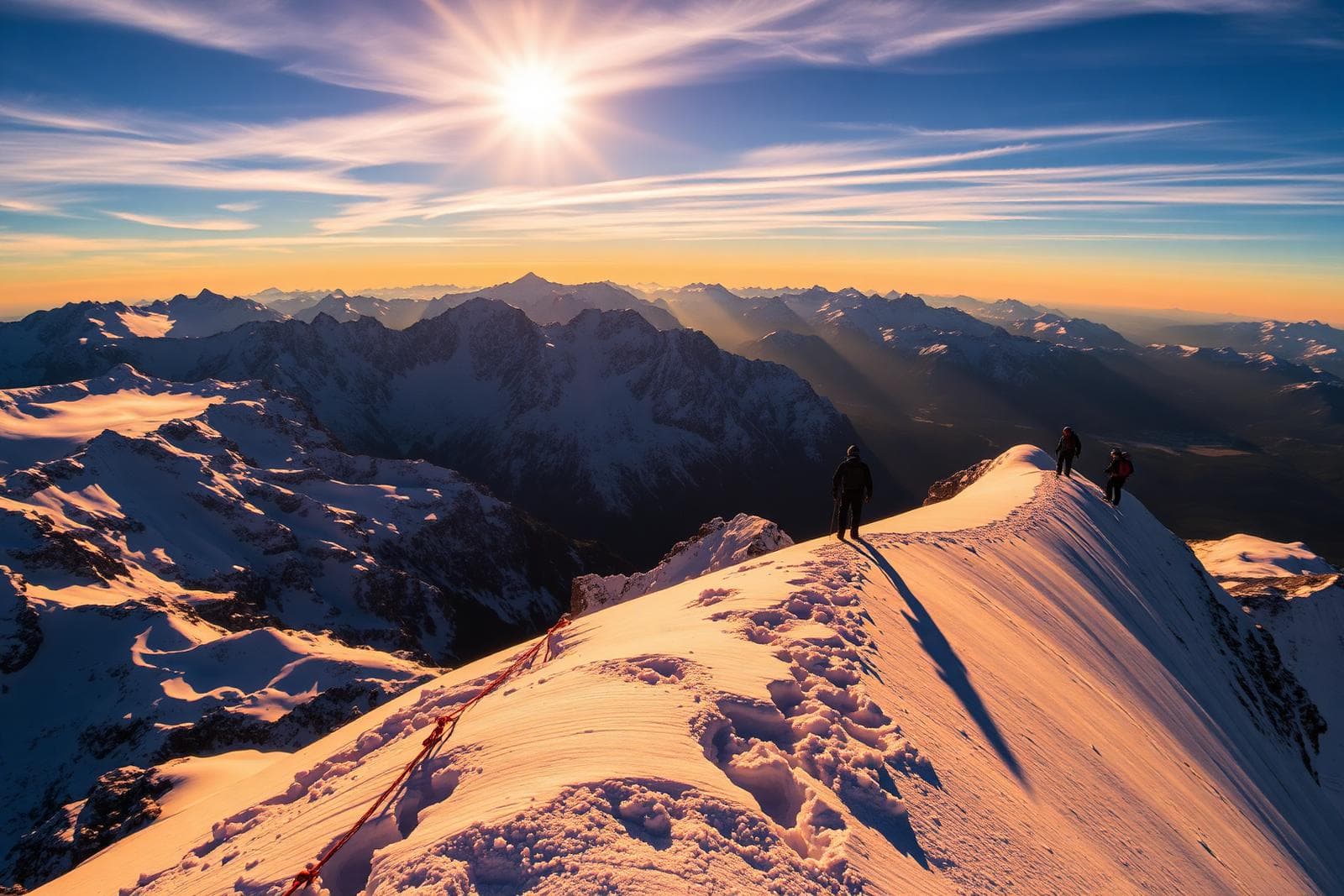
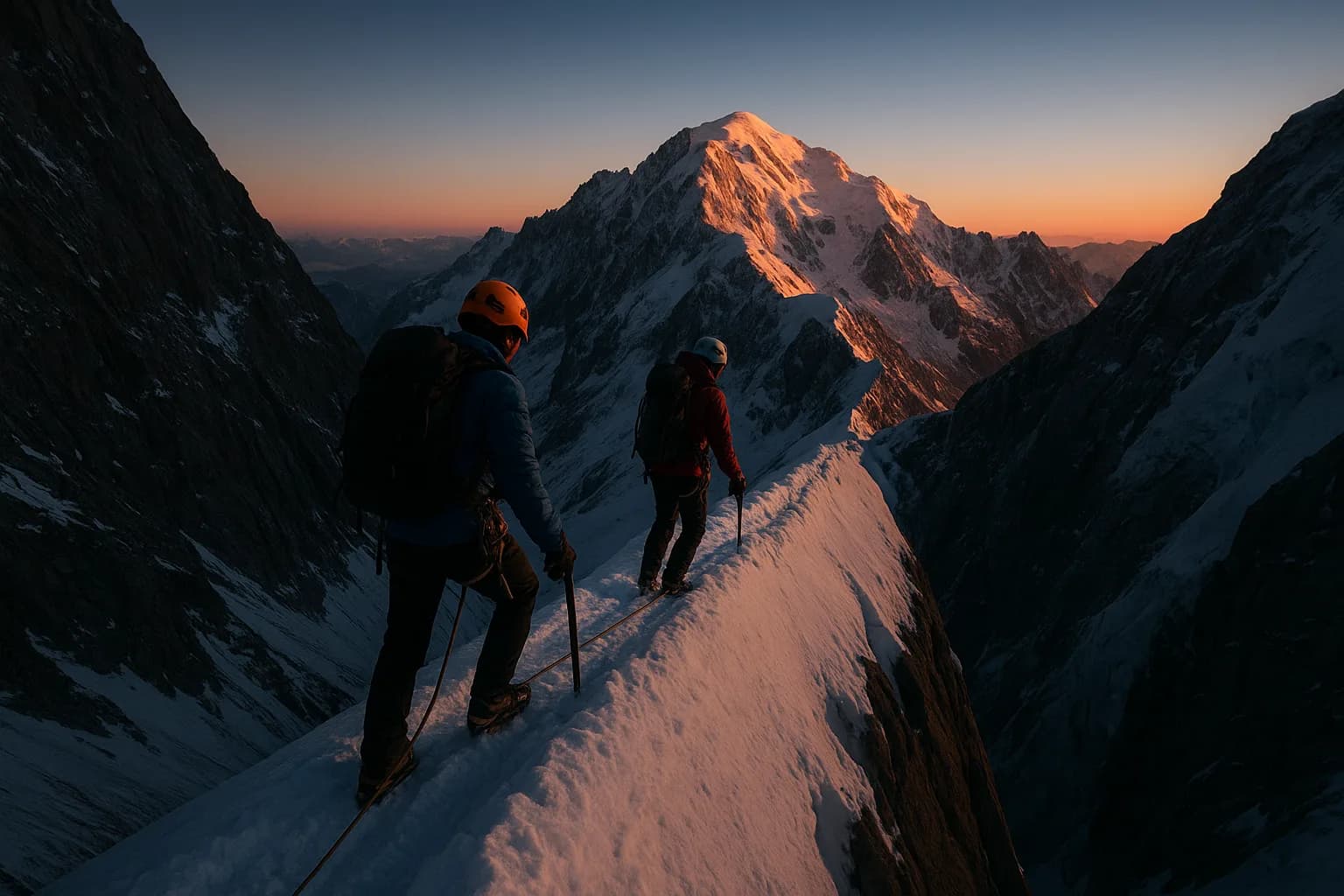
Departure between midnight and 2 a.m. from Cosmiques. The night departure is imposed by several constraints: (1) avoid daytime heat that destabilizes seracs below Tacul; (2) reach the summit before afternoon convection storms arrive in summer; (3) benefit from consolidated, frozen snow that is safer under crampons. Headlamp and full night equipment are essential.
Cosmiques → Mont Blanc du Tacul (4,248 m) — 2 to 3 hours. The rope team descends onto Géant Glacier, then climbs toward Mont Blanc du Tacul while passing under the seracs zone (to be traversed quickly). The slope increases progressively to Tacul's summit (4,248 m), the first 4,000 m peak of the traverse. In hard snow conditions, crampons work fully on slopes of 40°.
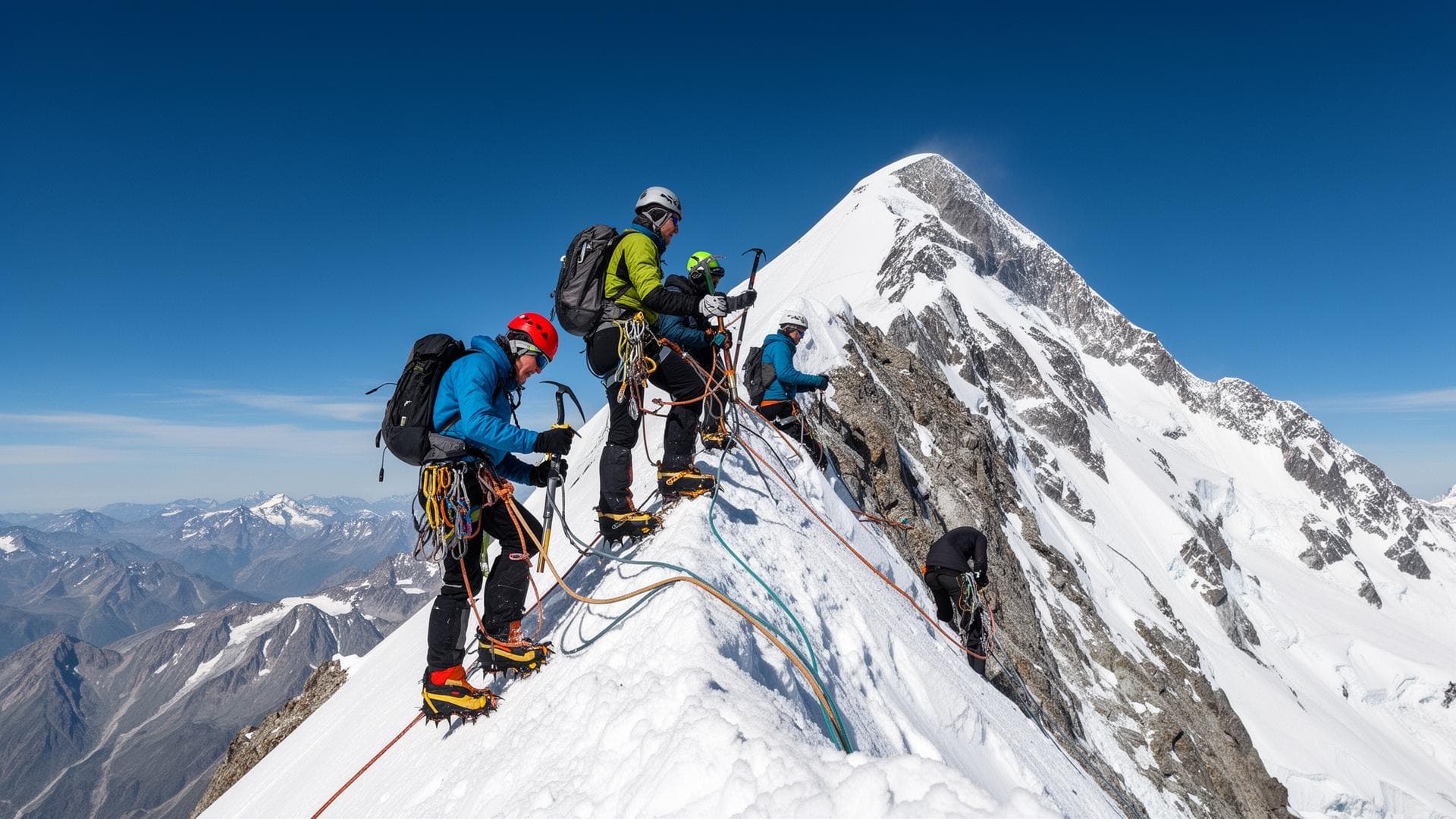
Tacul → Mont Maudit Col (4,345 m) → Mont Maudit (4,465 m) — 1 to 2 hours. This is the most delicate passage of the itinerary. Mont Maudit Col (4,345 m) is reached either by a steep gully exposed to seracs (direct route), or by a 50 m rappel on pre-installed anchors (classic in season). This rappel is technical and requires full mastery of rappelling techniques in cold conditions. From the col, the rope team climbs to Mont Maudit's summit (4,465 m) — the second 4,000 m peak of the traverse.
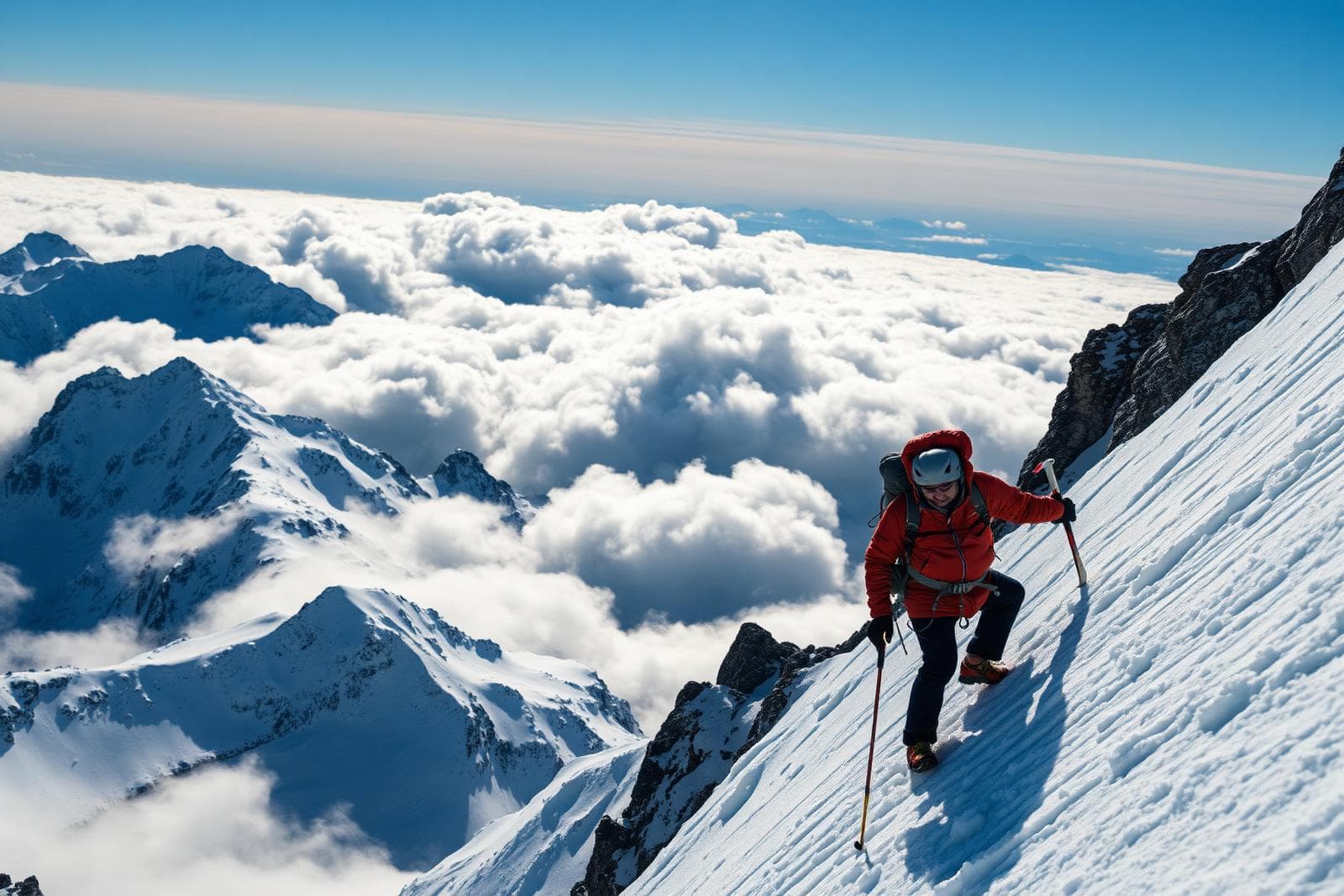
Mont Maudit → Brenva Col → Côte Wall → Mont Blanc (4,805.59 m) — 2 to 3 hours. From Mont Maudit, the rope team descends to Brenva Col (4,303 m), then attacks the Côte Wall — a slope of 45°–50° over about 200 m of height, at more than 4,600 m altitude. This is where altitude is most felt: oxygen deprivation aggravates muscle fatigue. The final ridge joins the Bosses ridge, shared with the Goûter route, and leads to the summit. Official altitude IGN/OGE 2021: 4,805.59 m.
Descent — 3 to 5 hours. The return is made by the same itinerary in reverse (climbing back up Mont Maudit Col by rappel may involve short downclimbing or a variant). The descent to Cosmiques, then the Aiguille du Midi ridge, must be completed before 2–3 p.m. to avoid heat and seracs risk in the afternoon.
Physical level
Excellent physical fitness required. The traverse chains approximately 1,200 m of elevation gain above 3,600 m over 5 to 8 hours of continuous night progression. ENSA recommends having previously bivouacked or slept at high altitude refuge, mastering snow travel for several consecutive hours, and having climbed at least one preparatory 4,000 m peak (Breithorn 4,164 m, Gran Paradiso 4,061 m, Dômes de Miage 3,673 m). Regular high mountain hiking (4–6 h, 1,000–1,500 m elevation gain) should be comfortable before considering this route.
Technical level
Rated PD+ to AD− depending on conditions (FFCAM/ENSA). Technical sections include: (1) the bergschrund at Tacul's base — crossable on snow or ice depending on season; (2) Mont Maudit Col (4,345 m) — seracs zone requiring speed, with optional 50 m rappel on anchors; (3) Côte Wall — slope of 45°–50° over 200 m at high altitude. 12-point crampons, ice axe, harness, minimum 50 m rope, and rope team glacier climbing technique (protection on ice screws or ice axes) are essential. This route is not suitable for alpine climbing beginners.
Difficulty details
The main difficulty of the Three Monts traverse is its commitment: once engaged on Géant Glacier, the rope team is far from any refuge for several hours, in a zone exposed to seracs. The succession of three 4,000 m peaks demands precise energy management. Mont Maudit Col may require rappelling in hard conditions. The official rating is PD+ (Moderately Difficult Plus) to AD− (More Difficult Minus) according to ENSA — significantly more technical than the Goûter normal route (PD−).
Specific risks
- Seracs below Mont Blanc du Tacul — traverse at night to minimize risk
- Crevasses on Géant Glacier — mandatory rope team progression
- Mont Maudit Col (4,345 m) — exposure to serac fall, delicate rappel
- Côte Wall — slopes at 45°–50° at more than 4,600 m, risk of serious fall
- Weather — frequent convection storms in summer from 1–2 p.m.
- Mountain sickness — insufficient acclimatization, especially during rapid ascent by cable car
- Variable conditions — hard snow, verglas or insufficient snow coverage depending on season
Huts and key points
- Cosmiques Refuge (3,613 m) — Chamonix Guides Company, ~80 places, mandatory online reservation
- Vallot Shelter (4,362 m) — unguarded emergency refuge, accessible from Bosses ridge in case of weather alert
Recommended equipment
- 12-point crampons (mandatory — compatible with rigid alpine climbing boots)
- Ice axe (50–60 cm depending on height)
- Harness + minimum 50 m rope (rope team of 2 to 3 people)
- Climbing helmet
- High altitude clothing: thermal base layer, mid-weight fleece, Gore-Tex windproof jacket, waterproof over-pants — for this kind of committing itinerary, French brands like Cimalp offer ultra-light hardshell jackets (around 380 g) with an Ultrashell® membrane, designed to reduce the weight carried by the rope team
- Glacier glasses (index 4 mandatory above 4,000 m)
- SPF 50+ sunscreen (intense exposure at altitude and on snow)
- Headlamp with spare batteries (mandatory night departure)
- Warm gloves + waterproof gloves (2 pairs recommended — one may freeze or get wet)
- Insulated bottle 1.5 L minimum (liquid water difficult to find outside refuge)
- Mountain sickness medications: ibuprofen, and acetazolamide on medical prescription if recommended
- Light bivy kit (emergency blanket, first aid kit)
Who is this route for?
Alpinists who have already climbed one or more 4,000 m peaks and who master glacier progression, steep crampon climbing, and basic belay techniques. The route is highly appreciated by rope teams guided by a professional mountain guide: the guide manages technical belaying at Mont Maudit Col and optimizes night schedules to minimize seracs risk.
When to avoid this route
Unstable seracs conditions reported (check with Chamonix Guides Company or PGHM), insufficient snow on Côte Wall (exposed rock), degraded weather from 11 a.m. on the day, or a rope team without prior experience on snowy glaciers and steep slopes.
Alternatives
Frequently asked questions
Sources
- FFCAM (French Federation of Alpine Clubs) — Mont Blanc Massif route topos
- ENSA (National School of Skiing and Alpinism, Chamonix) — technical levels required in alpine climbing
- Chamonix Guides Company — route technical sheets and 2026 prices
- Compagnie du Mont Blanc — Aiguille du Midi cable car 2026 prices
- refuge-des-cosmiques.com — Cosmiques Refuge prices and booking 2026
- IGN / OGE (National Geographic Institute / Order of Surveyors-Experts) — official Mont Blanc altitude 4,805.59 m (2021 measurement)
- PGHM Chamonix-Mont-Blanc — conditions, rescue statistics and schedule recommendations
- Altituderando — independent test of Cimalp's Ultrashell membrane (20,000 Schmerber / 80,000 g/m²/24h) : altituderando.com
Other ascent routes
Going further
Safety: Conditions in the high mountains change rapidly. The information on this page replaces neither the judgement of a high-mountain guide, nor weather bulletins, nor official information from huts and mountain safety organisations.