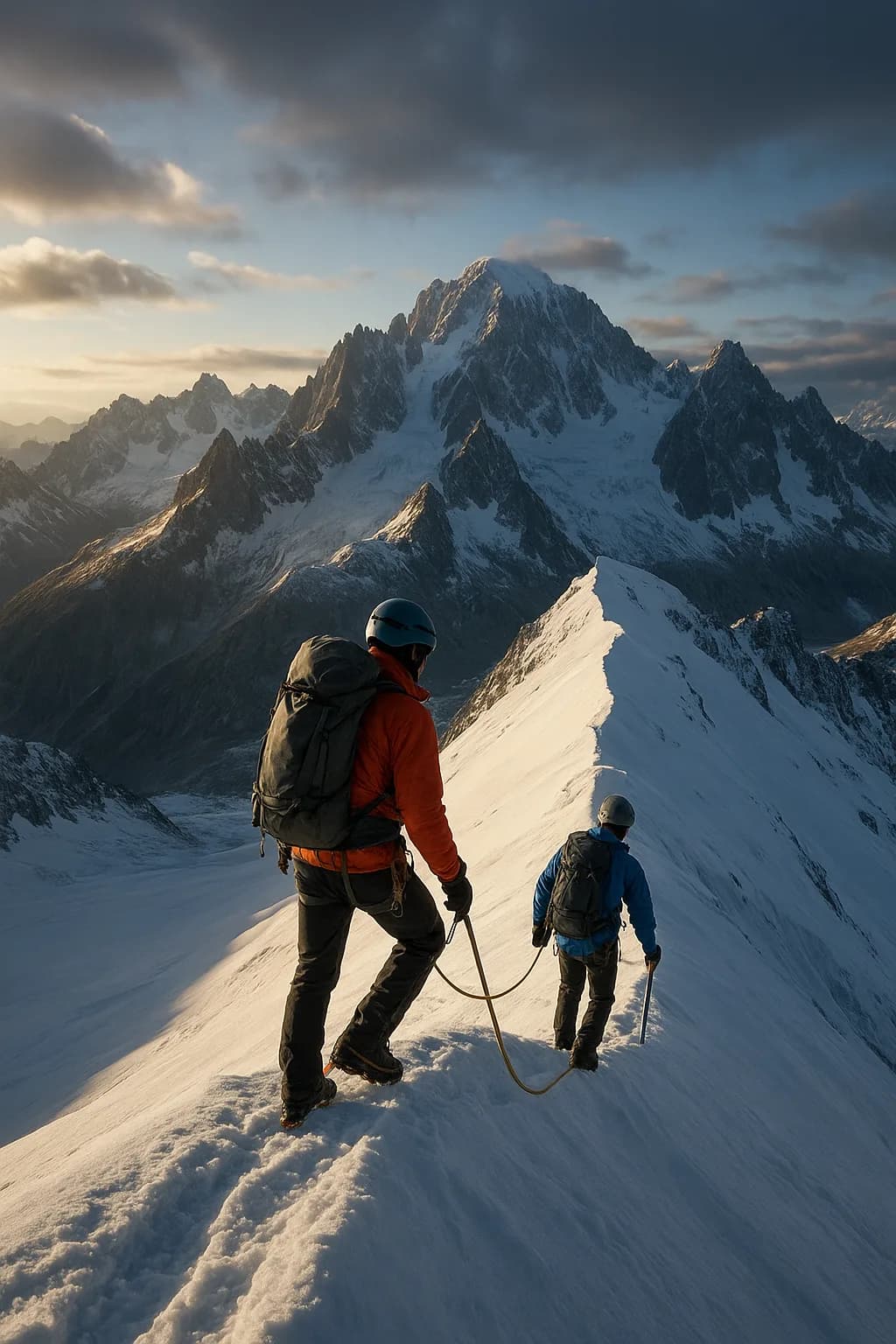
Mont Blanc with or without a guide?
Written by Victor Michel — history enthusiast and passionate alpinist based in Chamonix. Published May 10, 2026 · Updated September 8, 2026
Mont Blanc can be climbed without a guide, provided you are a genuinely self-sufficient mountaineer. For most candidates, guiding by a UIAGM mountain guide remains the safest option.
When a guide is essential
If you are not self-sufficient in roping up, cramponing, reading glaciers and making weather-based decisions, guiding by a UIAGM guide is essential. A guide does more than show the way: they decide in real time whether to cross the Grand Couloir based on freeze conditions, adjust the departure time to the day's weather, and make the turnaround call in place of a rope team that, worn down by fatigue or altitude, is losing judgment — precisely the decisions where accident data shows experience makes the difference.
What Goûter accident data shows
A mountain rescue study conducted with the PGHM on the Goûter route between 1990 and 2011 (Blaise Agresti) records 291 rescue operations, 74 deaths and 180 injuries. The Grand Couloir, which accounts for only 3% of the route's length, alone concentrates 47% of recorded accidents — a concentration of risk at one specific crossing point, not a uniform spread of danger across the whole route.
74 deaths
and 180 injuries recorded on the Goûter route between 1990 and 2011 (291 rescue operations)
PGHM / Blaise Agresti study
47%
of accidents concentrated in the Grand Couloir, which accounts for only 3% of the route's length
PGHM / Blaise Agresti study
728 hrs
of training over 4 to 6 years for the French State high-mountain guide diploma (UIAGM)
ENSA / UIAGM
When autonomy is really possible
For confirmed mountaineers, experienced on glaciers, capable of assessing conditions and taking full responsibility for every decision — including the decision to turn back. The criterion is not having already summited a 4,000m peak, but fully and independently mastering the actions a guide normally performs: reading hidden crevasses, choosing the window to cross the Grand Couloir, managing a rope team in the event of a glacier incident.
The UIAGM guide's role
The French State diploma of high-mountain guide, which grants the international UIAGM label, represents up to 728 hours of training over a 4-to-6-year course at the ENSA (École Nationale de Ski et d'Alpinisme), preceded by selection tests. The UIAGM, founded in 1965, today brings together nearly 6,000 guides across around twenty countries — it is this level of requirement, not just personal experience, that distinguishes a certified guide from a confirmed mountaineer.
| Criterion | With a guide | Without a guide |
|---|---|---|
| Safety | Strengthened by expertise | Rests entirely on the rope team |
| Logistics | Often handled for you | Entirely to organize |
| Cost | Higher | Reduced |
| Decision-making | Shared with a professional | 100% up to the rope team |
| Profile | Without sufficient alpine experience | Confirmed, self-sufficient mountaineers |
Read next
FAQ
Is it mandatory to hire a guide?
No, but it is strongly recommended without confirmed glacier mountaineering experience.
How do I check that a guide is qualified?
Check UIAGM / SNGM certification or consult the official directory at sngm.com.
What level of mountaineering is required to climb without a guide?
Full mastery of cramponing, roping up on glaciers, reading crevasses and independent weather-based decision-making. Recommended minimum: several PD/AD routes with high-altitude bivouacs.
How much does a guide cost for the Mont Blanc ascent in 2026?
€800 to €1,400 for a private rope team (guide service only, 2 days). In group format, the Chamonix Guides Company all-inclusive package is €2,580/person. Source: chamonix-guides.com.
What additional risks exist without a guide?
Glacier navigation, managing crevasses and seracs, independent weather reading and turnaround decisions. Every team member must be able to handle an emergency alone.
Can a group of friends climb without a guide if one is experienced?
Yes, no law prohibits a self-sufficient rope team ascent in France. However, each member bears full responsibility for their own safety. The most experienced climber in the team must master glacier travel, crevasses, the Grand Couloir and high-altitude weather — not merely have summited before.
What insurance covers accidents without a guide on Mont Blanc?
FFCAM's Assistance Secours France/EU/Morocco option costs €25/year (€20 under 24) on top of base membership, and includes mountain rescue and repatriation insurance. Specialized insurers (Mountain Wilderness, Allianz Assistance, AWP) cover mountain rescue and evacuation. The PGHM itself is free for a life-threatening emergency, but may direct climbers to a private helicopter if the situation is judged reckless rather than vital — see rescue and insurance on Mont Blanc.
How do I find and book a mountain guide for Mont Blanc?
Check the official SNGM directory (sngm.com) to verify certifications, or book directly through guide companies: Chamonix (chamonix-guides.com), Évolution 2 (evolution2.com), Chamex (chamex.com). For July–August, book between November and March — slots on the Goûter route fill up within weeks.
Is the Grand Couloir really more dangerous than the rest of the Goûter route?
Yes, markedly so: over the 1990–2011 period, this crossing accounts for only 3% of the route's length but concentrates 47% of accidents recorded by the PGHM. This is why the choice of crossing window — a decision a guide makes in real time based on freeze conditions — matters as much as the rope team's technical level.
How long does it take to become a UIAGM high-mountain guide?
The French State diploma represents up to 728 hours of training at the ENSA, spread over a 4-to-6-year course and preceded by selection tests. It then grants the international UIAGM label, which brings together nearly 6,000 guides across around twenty countries.