Ascent route
Brouillard Face: expert mountaineering on Mont Blanc
The Brouillard Face is one of the wildest and most committing sectors of the Mont Blanc massif. Facing the Italian side, it groups several classic major mountaineering routes: the Innominata, the Peuterey Ridge and the Route Major. These routes are exclusively for highly experienced teams, accustomed to long routes on ice and rock at high altitude.
Written by Victor Michel — history enthusiast and passionate alpinist based in Chamonix. Published May 7, 2026 · Updated August 26, 2026 · 7 min read
Quick summary
The Brouillard Face lies on the south-west flank of Mont Blanc (Italian side, Val Veny). It concentrates long, committing, rarely-traveled routes with rock and ice sections graded TD to ED. The Gonella hut (3,071 m, CAI) is the main logistical base for the sector's routes. Access from Chamonix is via the Mont Blanc tunnel or Col du Géant.
Key takeaways
- Face: Italian (Val Veny, Courmayeur side)
- Signature routes: Innominata (AD/D), Peuterey Ridge (TD+), Route Major (TD)
- Main hut: Gonella (3,071 m, CAI) — sector's logistical base
- Access: Mont Blanc tunnel or Col du Géant from Chamonix
- Intended for: highly experienced teams only — rock, ice, serious commitment
- Length: routes 1 to 2 days from the hut, with possible bivvy
Technical data
- FaceItalian — Val Veny (Courmayeur, Aosta Valley)
- AccessMont Blanc tunnel (Chamonix → Courmayeur) or Col du Géant · Val Veny → Gonella Hut
- Base hutGonella Hut (3,071 m) — managed by CAI (Club Alpino Italiano) · reservation recommended
- Main routesInnominata (AD/D), Peuterey Ridge (TD+), Route Major (TD), Brenva Ridge (AD)
- GradesAD to ED depending on route and conditions — expert sector only
- CharacterWild, long, committing — limited rescue availability, far from rescue centers
- Summit elevation4,805.59 m (official IGN/OGE measurement 2021)
- SeasonOptimal snow/ice conditions: mid-June to mid-August
Overview of sector routes
Innominata Route (AD to D depending on conditions)
The Innominata is the most accessible route on the Brouillard-Brenva sector on the Italian side. It climbs the glaciated slopes of the south-west face from Gonella hut (3,071 m), crosses sections of rock and ice before joining the summit ridge. The AD (Assez Difficile/Fairly Difficult) grade can become D (Difficile/Difficult) in degraded conditions. It's a 2-day route with a high bivvy or return to the hut. Traffic: light.
Peuterey Ridge (TD+)
The Peuterey Ridge is one of the great rock routes on the Mont Blanc massif, graded TD+ (Très Difficile+/Very Difficult+). This rock pillar on the Brouillard face offers V/V+ pitches on granite at high altitude. Access and descent require mastery of the Brouillard glacier. Reserved for experienced climbers, accustomed to long alpine climbing and rappelling in alpine conditions. Route time: 8 to 14 hours.
Route Major (TD) — historic route, opened 1928
Opened in 1928 by Britons Graham Brown and Frank Smythe, Route Major is one of the great historic routes on the Brenva face. It climbs the east face of Brenva via an ice gully and mixed ridges. Graded TD (Très Difficile/Very Difficult), it is associated with pioneers of modern mountaineering and remains an excellent route for highly experienced teams. Length: 1,200–1,500 m of elevation from Val Veny.
Access to the sector from Chamonix
Access to the Brouillard-Gonella face from Chamonix is typically via the Mont Blanc tunnel (road) toward Courmayeur, then Val Veny to Visaille. From there, the path to Gonella hut (3,071 m, CAI) takes approximately 3 to 4 hours. An alternative via Col du Géant (Aiguille du Midi → Géant → Eccles → Gonella) is possible for teams wanting to avoid the road section.
Physical level
Very high physical fitness required. Routes on the Brouillard sector last 8 to 16 hours from the hut, with 1,500–1,800 m of elevation on mixed rock-ice terrain. Teams must be able to maintain a steady pace for several hours at high altitude (3,500–4,800 m), often with a wall bivvy. Technical mountaineering training over several seasons is essential.
Technical level
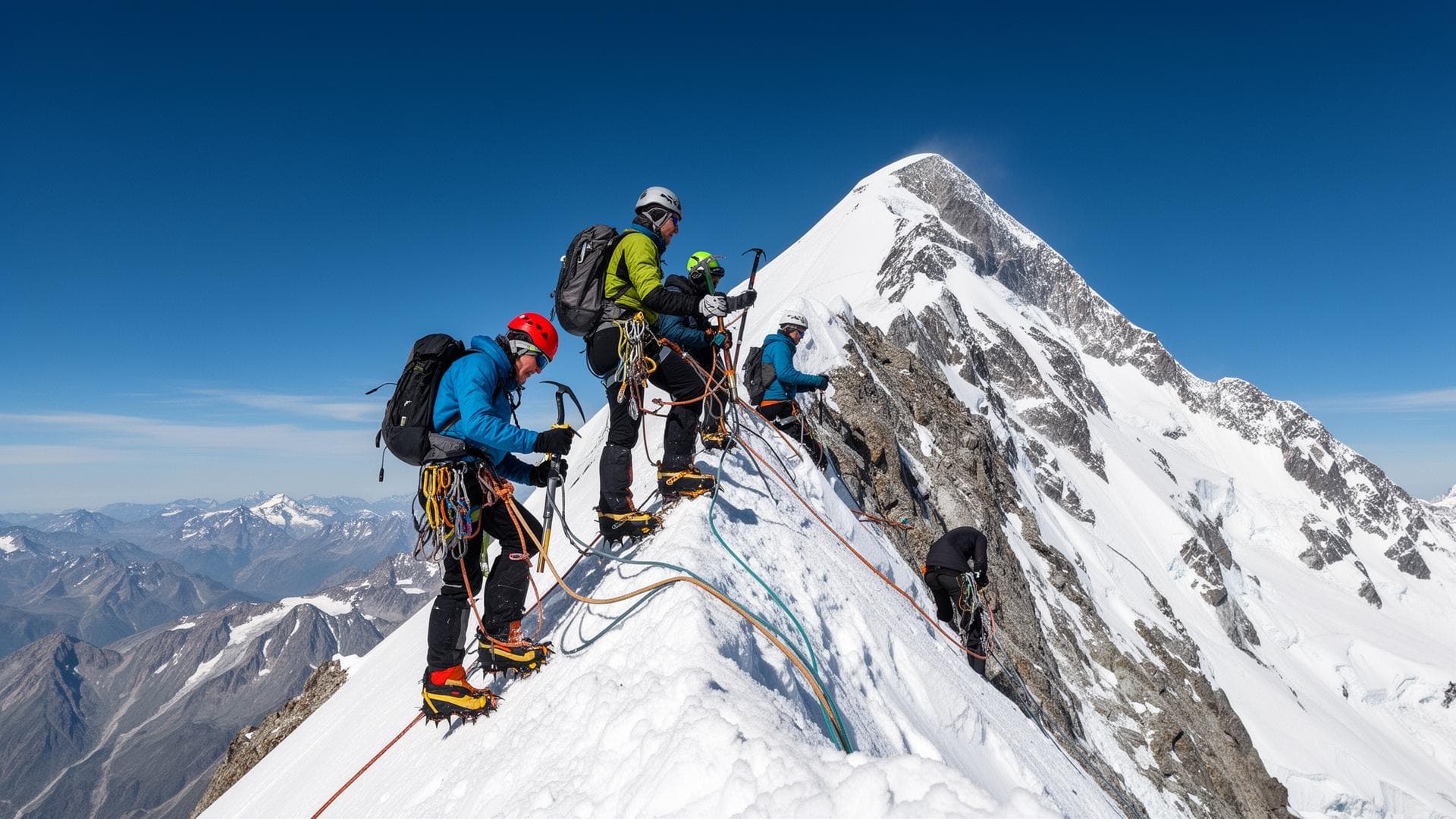
Sector reserved for highly experienced teams. Grades range from AD (Innominata) to ED (extreme Peuterey pitches). Required skills: cramponed progress on ice at 50°+, rock climbing to V/V+ in alpine terrain, anchor placement on ice and rock, rappelling in degraded conditions. Prior experience on other major alpine routes (Frendo Spur, North Face of Orion, Drus) recommended.
Difficulty details
The Brouillard sector stands out for its wild character and remoteness from rescue services. The Chamonix PGHM and Aosta Valley Alpine Rescue manage interventions, but a wall rescue on this face could take several hours. Commitment is therefore considerable: the team must be able to autonomously handle an emergency situation (forced bivvy, bad weather, minor injury). Snow and ice conditions on this south-west facing slope change rapidly in summer.
Specific risks
- Seracs on the Brouillard glacier — ice avalanche risk to account for
- Loose or snow-covered rock — granite quality variable by altitude and sector
- Significant commitment — far from rescue, no refuge available on the route
- Weather conditions — south-facing slope exposed to heat, afternoon instability
- Navigation — few markers on these little-traveled routes, difficult in poor visibility
- Descent — long, complex rappels to return to Gonella hut
Huts and key points
- Gonella Hut (3,071 m) — CAI (Club Alpino Italiano), ~35 beds, reservation recommended in peak season
- Eccles Bivvy (3,850 m) — unmanaged, 12 beds, accessed via Col Moore — high hut option for some routes
Recommended equipment
- 12-point crampons suitable for ice and mixed terrain
- Standard ice axe (50–60 cm) + second ice axe or ice hammer for ice routes
- Harness + double rope 50 m (60 m recommended for rappels)
- Helmet mandatory (rockfall on loose rock)
- Ice climbing gear: ice screws, wedges, friends as needed for route
- High-altitude clothing: layering system, Gore-Tex, technical gloves
- Light bivvy: sleeping bag −15°C, lightweight tent or bivy bag
- Rations for minimum 2 days away from hut
- Headlamp with spare batteries (bivvy or early start)
- Glacier goggles, shade 4, mandatory
Who is this route for?
Mountaineering teams with proven experience on long routes (ice gullies, mixed climbing, alpine rappelling). This sector is not suitable for first big routes or mountaineers in training. A qualified mountain guide is strongly recommended for a first visit to the sector.
When to avoid this route
Unstable weather, high heat on south face (ice melt), team without alpine rappelling experience, or lacking recent practice on ice and rock at high altitude.
Alternatives
Frequently asked questions
Other ascent routes
Going further
Safety: Conditions in the high mountains change rapidly. The information on this page replaces neither the judgement of a high-mountain guide, nor weather bulletins, nor official information from huts and mountain safety organisations.