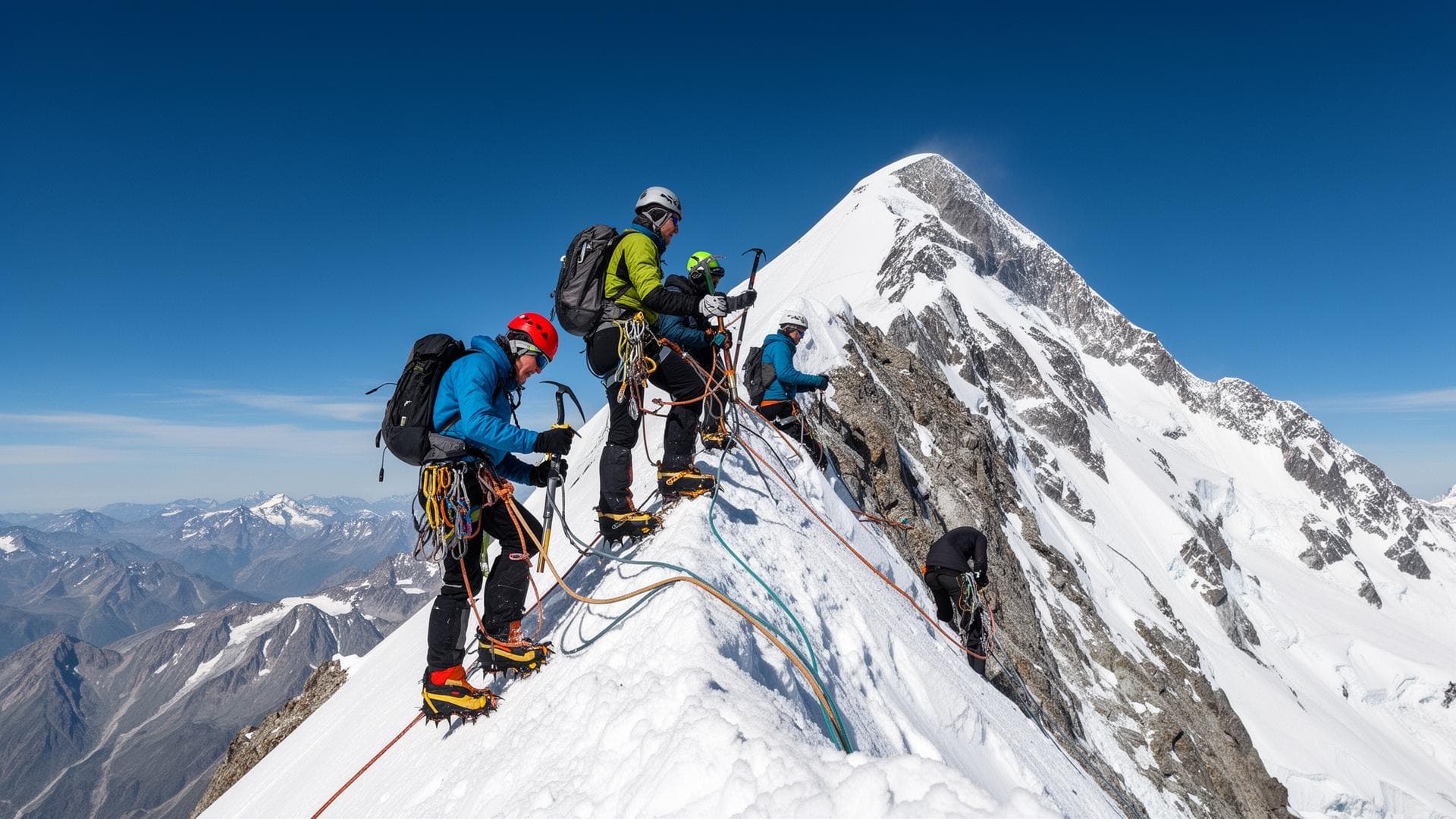
Refuge du Goûter or Tête Rousse?
Written by Victor Michel — history enthusiast and passionate alpinist based in Chamonix. Published May 10, 2026 · Updated August 10, 2026
On the normal route, the choice of refuge — Tête Rousse or Goûter — directly affects your departure time, crossing the Grand Couloir and managing fatigue. FFCAM centralizes reservations.
Choosing Tête Rousse
Favored for better sleep and recovery, at the cost of a longer summit day and a double Grand Couloir crossing.
Choosing Goûter
Higher position means a shorter summit day, but more difficult sleep and more demanding acclimatization.
Availability
Booking is very competitive in season. Always verify directly with FFCAM.
| Criterion | Tête Rousse | Goûter |
|---|---|---|
| Altitude | ≈ 3,167 m | ≈ 3,835 m |
| Position | Before the Grand Couloir | Above the Grand Couloir |
| Acclimatization | Gentler | More abrupt |
| Grand Couloir crossing | Both ways | Before the refuge, at night |
| Sleep quality | Better (lower altitude) | More difficult |
| Strategy | Very early departure to summit | Shorter from the refuge |
Read next
FAQ
What's the altitude difference between Tête Rousse and the Goûter hut?
Tête Rousse sits at around 3,167 m, the Goûter hut at around 3,835 m — a gap of roughly 670 m.
Do you cross the Grand Couloir twice via Tête Rousse?
Yes, both ways, unlike the Goûter route where the crossing happens before the hut, at night.
Which hut offers better sleep?
Tête Rousse, thanks to its lower altitude — sleep at the Goûter hut is generally more difficult.
Where do you book a hut on the normal route?
FFCAM centralizes reservations for both huts; booking is very competitive in season.
Which hut gives the shortest summit day?
The Goûter hut, thanks to its higher position on the route.