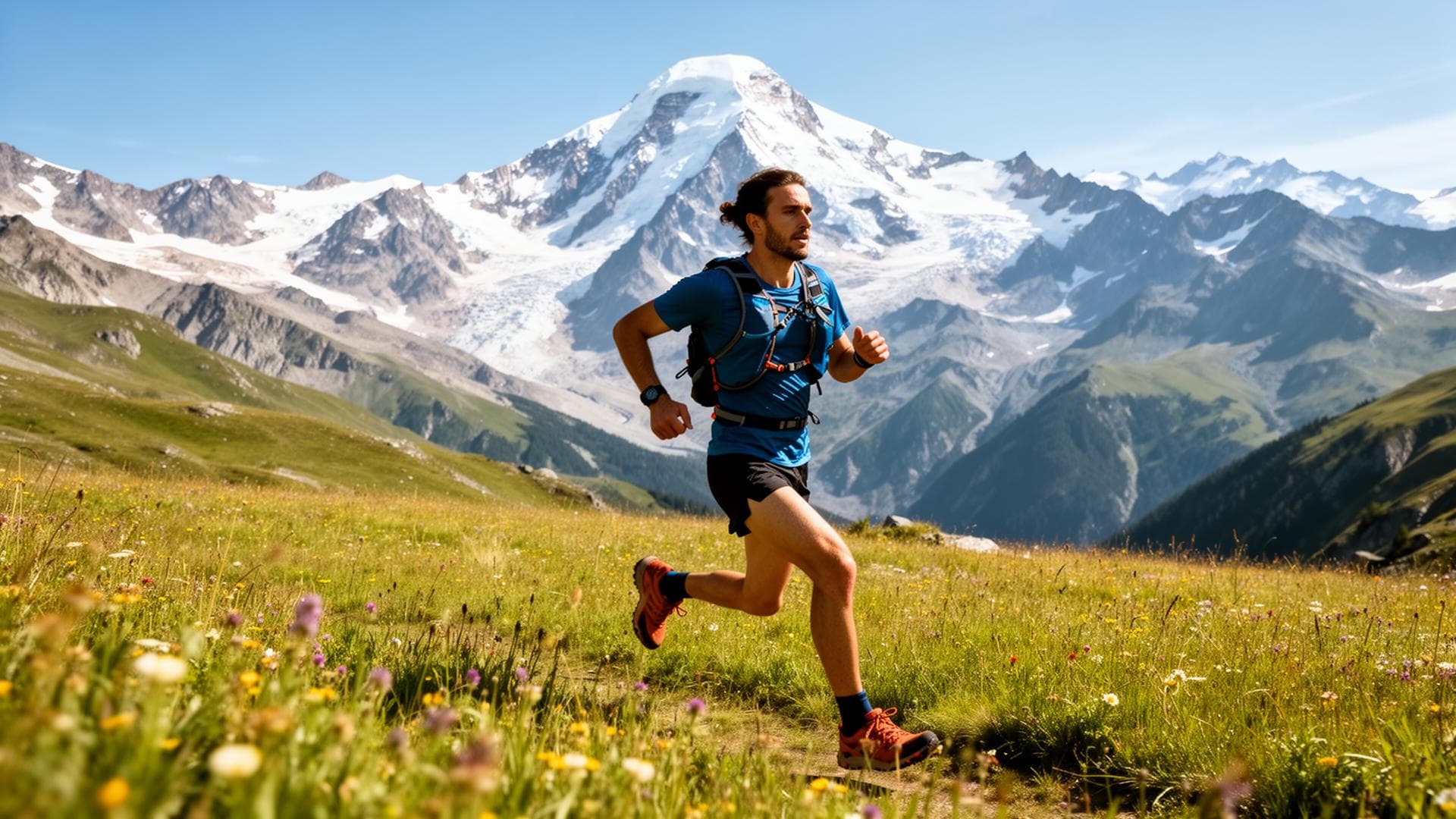
Trail Training for the Mont Blanc Marathon: 42 and 90 km Training Plan
Written by Victor Michel — history enthusiast and passionate alpinist based in Chamonix. Published August 7, 2026 · Updated August 26, 2026 · 5 min read
Training for the Mont Blanc Marathon is a runner's training, not a mountaineer's: what matters isn't altitude or technical gear (ice axe, crampons), but cumulative elevation gain, the descent, and endurance over several hours of effort. A reference plan for a 40-45 km format with around 3,000 m of elevation gain — close to the profile of the Mont Blanc 42 km — spans 12 weeks, with 3 running sessions and 1 to 2 strength sessions per week.
Key takeaways
- 12 weeks of structured training for a format close to the Mont Blanc 42 km (reference: 40-45 km trail, 3,000 m D+)
- 3 running sessions + 1-2 strength training sessions per week
- Descent: dedicated training is essential, muscles brake eccentrically — far more damaging than the climb
- 500 to 800 mL of fluid per hour of effort, to test in training before race day
Trail running or mountaineering: two different types of preparation
The Mont Blanc Marathon requires neither crampons nor a rope: it's a trail running event, where the difficulty comes from cumulative elevation gain and effort duration, not glacier technique. Preparing for the ascent of the summit itself (the Goûter normal route, roped travel, altitude above 4,000 m) follows an entirely different logic — see our dedicated guide to physical preparation for high mountains.
How long to train, depending on the distance targeted
A reference plan for a 40 to 45 km trail with around 3,000 m of elevation gain — a profile close to the Mont Blanc 42 km (2,540 m D+) — spans 12 weeks, with 3 running sessions and 1 to 2 strength training sessions each week. Long runs build up progressively to around 2h30 on uneven terrain. For the 90 km (≈ 6,200 m D+), training requires a higher volume and an already-established trail running base; for the 23 km or 10 km, a shorter plan is enough.
12 weeks
duration of a reference plan for a 40-45 km trail / 3,000 m D+, close to the profile of the Mont Blanc 42 km
Le Papé Info
500-800 mL
recommended fluid intake per hour of effort, to test in training
RunMotion Coach
200-400 m D+
recommended starting elevation gain for the first outings, to increase progressively
RunMotion Coach
Training both the climb AND the descent
Hill sessions (repeats uphill at varying intensity) build the power needed on sections like the aiguillette des Posettes or the technical parts of the 90 km. The descent deserves dedicated training in its own right: the quadriceps brakes the body through eccentric contraction, a movement far more damaging to muscle fibers than the effort of climbing — neglecting this specific training is a common cause of debilitating muscle soreness after the race.
Progressing without getting injured
Start elevation-gain runs with short sessions, in the range of 200 to 400 m D+, before increasing progressively, rather than jumping straight into long outings. Proprioception work and strength training (core work, squats, stair climbing) complement regular runs to limit injury risk on uneven terrain.
Nutrition and hydration on race day
Plan for 500 to 800 mL of fluid per hour of effort, adjusted to the forecast weather — a benchmark to test in training, never discovered for the first time on race day. The food reserve is part of the mandatory kit checked at bib pickup for the semi-autonomous races (23, 42, 90 km): train yourself to eat at race pace, not just while fasted or at rest.
Read next
- → Mont Blanc Marathon: dates, course, prices — the complete guide
- → Mont Blanc Marathon course: profiles and difficulty by distance
- → History of the Mont Blanc Marathon: from the Cross du Mont-Blanc to today
- → Mont Blanc Marathon or UTMB: which race to choose?
- → Physical preparation for high mountains (summit ascent)
FAQ
How long does it take to train for the Mont Blanc 42 km?
About 12 weeks of structured training, modeled on a reference plan for a 40 to 45 km trail with 3,000 m of elevation gain — a profile close to the Mont Blanc 42 km (2,540 m D+). The volume and duration of long runs increase progressively up to around 2h30 on uneven terrain.
Does the Mont Blanc 90 km require different training?
Yes. The 90 km (≈ 6,200 m D+, 24-hour cutoff) requires a higher training volume and an already-established trail running base, unlike the 42 km or 23 km, which are accessible with shorter preparation.
How do you train for the descent in the Mont Blanc Marathon?
Through dedicated outings on technical terrain: the quadriceps works through eccentric contraction to brake the body, a movement more damaging to muscle fibers than climbing. Neglecting this specific training is a common cause of debilitating muscle soreness after the race.
How much water should you drink during the Mont Blanc Marathon?
500 to 800 mL per hour of effort on average, adjusted to the weather forecast for race day — a benchmark to validate in training rather than discover on race day. The minimum water reserve carried at the start is part of the mandatory kit checked at bib pickup.
Do you need strength training to prepare for a trail race like the Mont Blanc Marathon?
Yes: strength training and core work are an integral part of trail preparation, alongside running sessions — not just for performance, but to reduce injury risk on uneven terrain over several hours of effort.
Can you prepare for the Mont Blanc Marathon without mountain trail experience?
The 10 km and 23 km remain accessible to runners without prior mountain trail experience, with progressive training. The 90 km, on the other hand, is aimed at runners who already have an ultra-trail experience base.